 overseasales@jwele.com.cn
 English

 Login


Teat from compact enclosures, which can provide greater thermal headroom for demanding workloads. For B2B buyers evaluating an ODM platform, the key is to validate the complete thermal design against the needs of the final product.he right cooling design depends on sustained workload, processor power, ambient temperature, enclosure constraints, noise limits, and maintenance access. Fanless MINI PCs prioritize silent operation and the absence of a cooling fan. Actively cooled systems use forced airflow to remove more h

What's the Difference Between Fanless and Active Cooling?
The main difference is how heat leaves the system. A fanless MINI PC transfers heat from the processor through thermal interfaces to the chassis or heat sink, where it dissipates through natural convection and radiation. Because the cooling system has no fan, it avoids fan noise and fan-related maintenance, although the enclosure may still need openings to release heat.
An actively cooled MINI PC uses a fan to move air across the heat-sink fins. Forced airflow can increase heat removal in a compact chassis, making active cooling a practical option for higher sustained power or heavier workloads. Neither design is automatically better: suitability depends on the intended workload and operating conditions.
Factor | Fanless | Active Cooling |
Heat removal method | Conduction to chassis + natural convection | Forced airflow across heat sink fins |
Sustained performance headroom | Constrained by passive dissipation capacity | Higher; scales with fin density and fan speed |
Fan noise | None | Varies with RPM and workload |
Dust ingress risk | Minimal — no air intake vents | Possible through intake vents; filtration may be needed |
Maintenance | Clean external surfaces periodically | Clean vents, filters, and fan blades periodically |
Typical CPU TDP class | Up to ~28 W in compact designs | 28 W and above; practical up to 65 W+ in small form factors |
For brands looking to customize MINI PC products in bulk, when selecting suppliers, ask suppliers for the cooling setup and test conditions for the exact CPU model and chassis revision. Do not rely only on the product category.
How Cooling Design Affects Hardware Performance and Longevity
A system’s thermal design must remove enough heat to keep its components within their operating limits. If the processor reaches a thermal limit, it may reduce clock speed or power to control temperature. This behavior is known as thermal throttling. As a result, a MINI PC that performs well in a short benchmark may deliver lower throughput during a long workload.
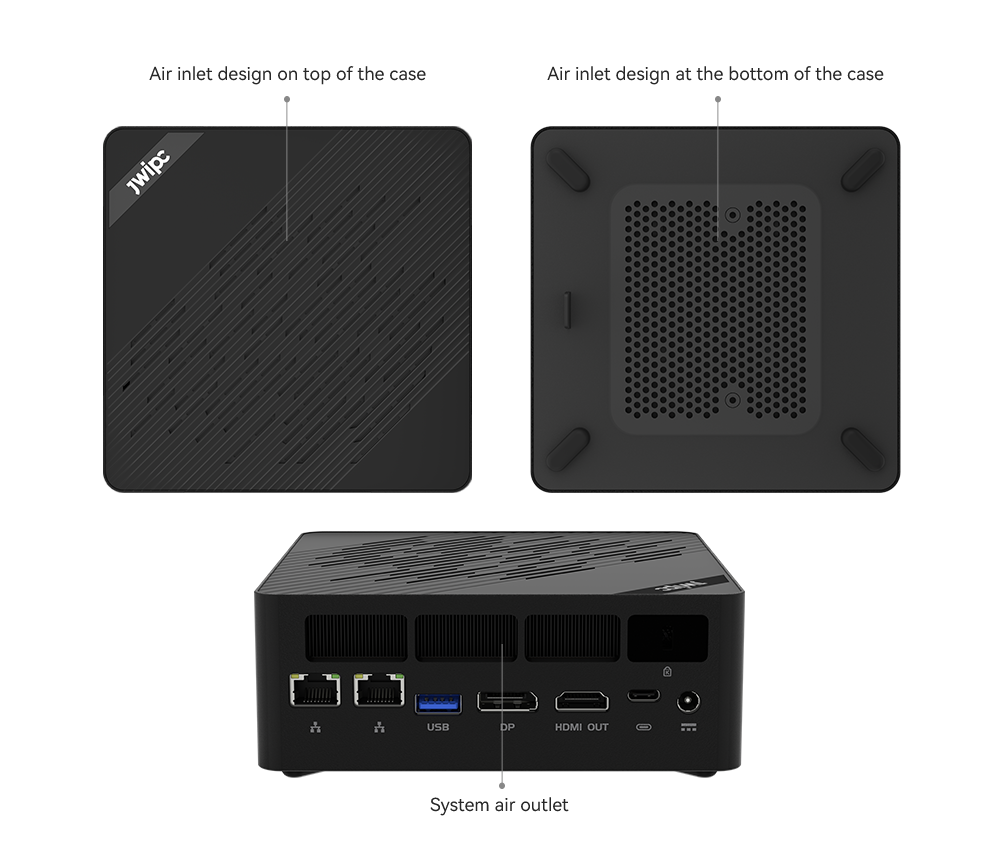
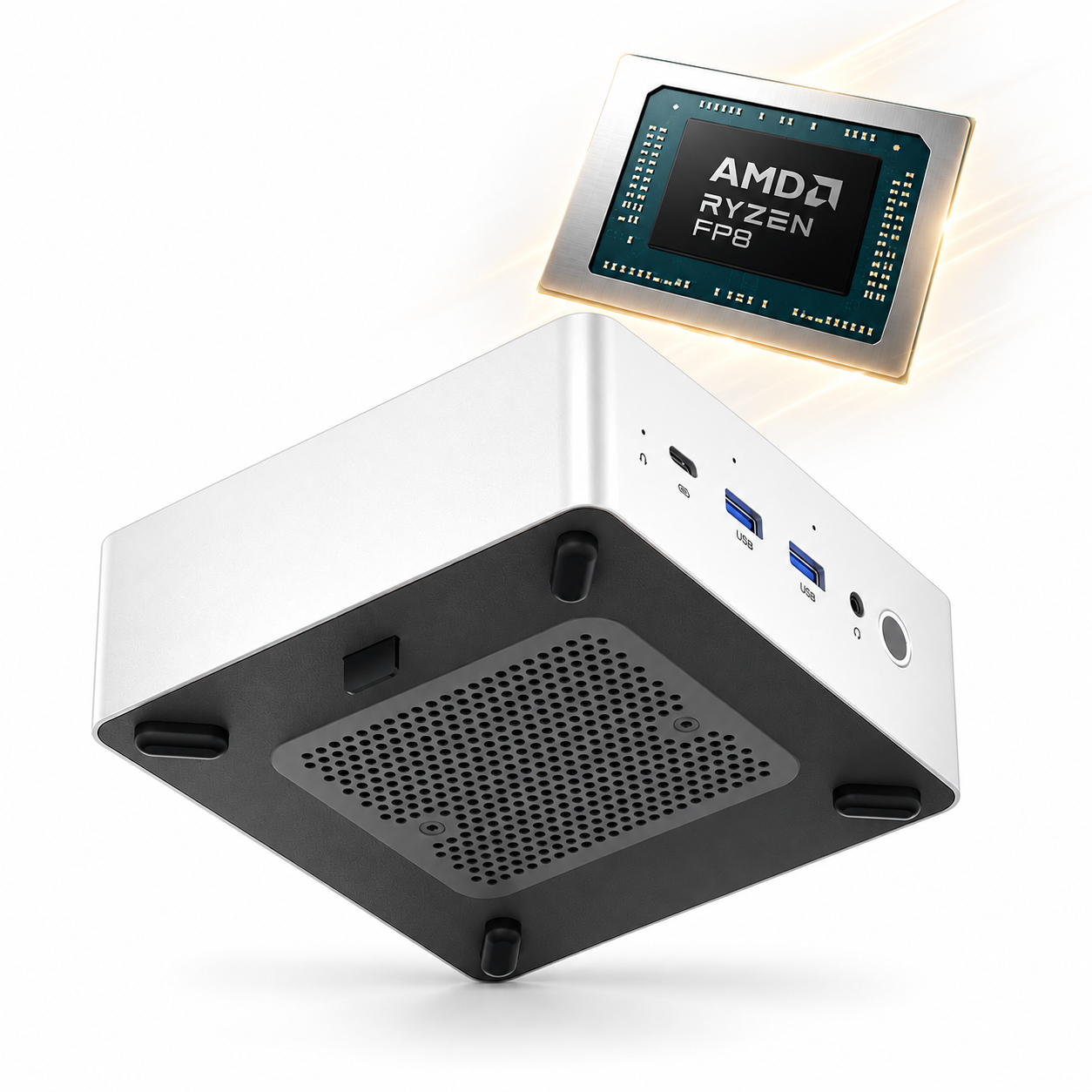
Active cooling can help a MINI PC sustain processing power within a compact chassis, provided the thermal system is designed for the heat generated under sustained workloads. The JWIPC M224 is an example of an actively cooled MINI PC built around AMD FP8 processors, supporting AMD Ryzen AI 300 Series and Ryzen 200 Series processors with a maximum listed TDP of 65 W. This MINI PC uses an active cooling approach; however, processor platform and product-specific thermal results should be assessed separately.
What Makes an Active Cooling System Work?
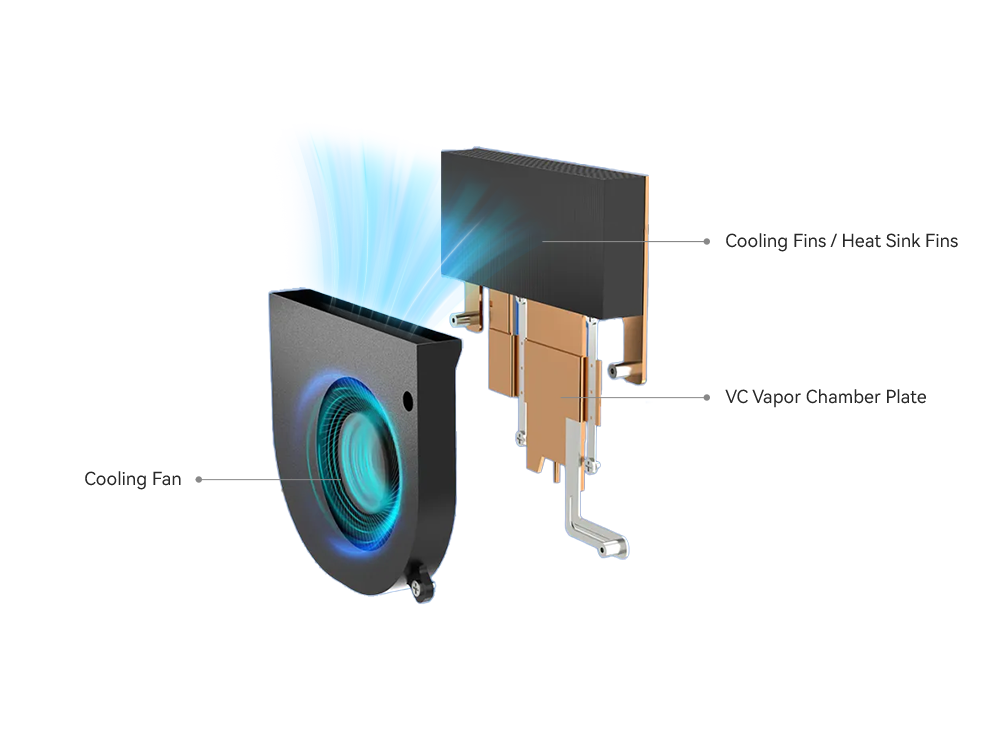
An effective cooling solution depends on the vapor chamber, fan, heat-sink fins, and chassis airflow working together. A larger heat sink cannot reach its potential without sufficient airflow, and a faster fan cannot compensate for an undersized heat-transfer path.
Vapor chamber: A sealed, flat heat-transfer structure uses a working fluid to move heat from the processor area and spread it across a wider surface. This can help reduce localized hot spots and make better use of the fin stack.
Fan: The fan forces air through the fins and helps carry heat out of the enclosure. Fan speed may be adjusted in response to temperature or power, balancing cooling capacity against noise.
Heat-sink fins: The fins increase the surface area available for heat exchange. Their geometry and spacing affect how evenly air moves through the stack and how effectively heat is released.
The airflow path through the chassis matters as much as the individual components. Intake openings, internal channels, component placement, and clearance beneath the enclosure can all affect how effectively heat is carried away from the CPU, SSD, memory, and other components.
Active Cooling in the JWIPC M224
In the M224, an active thermal system coordinates heat transfer from the processor, a fan driving airflow, heat-sink fins, and chassis ventilation. Its operating principle is as follows:
Heat spreading: A heat-transfer structure moves heat away from the processor area and distributes it across a larger surface before it reaches the heat-sink fins.
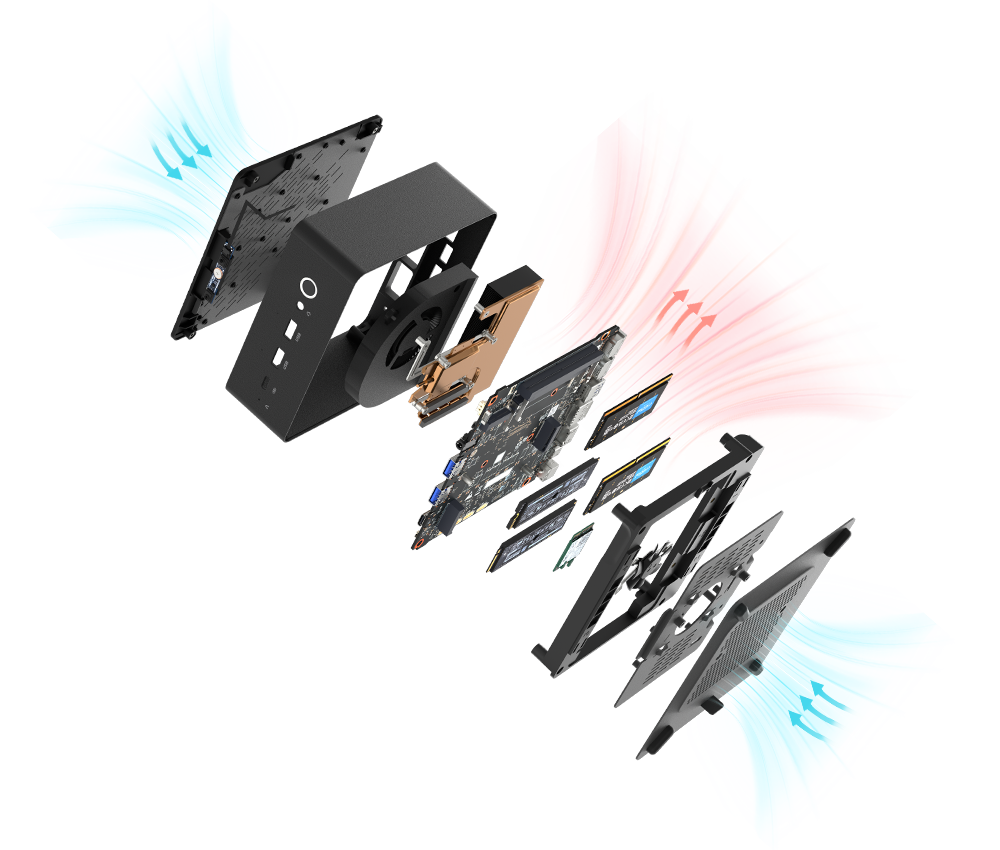
Fan: The fan drives air through the heat-sink fins and helps carry heat out of the enclosure. Fan design and control affect cooling capacity and acoustic performance.
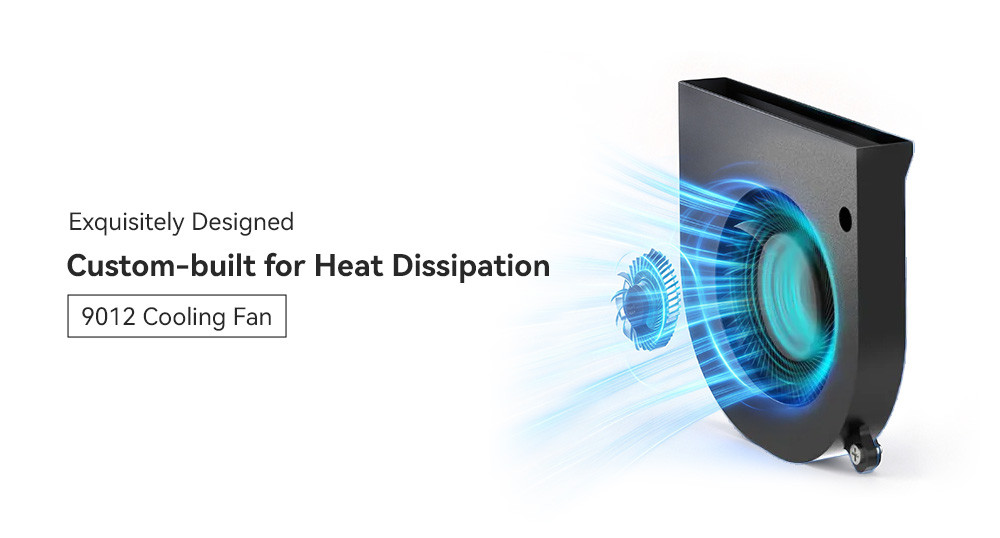
Heat-sink fins: The fins increase the surface area available for heat exchange. Their geometry and spacing affect airflow and heat dissipation.
When Is an Actively Cooled MINI PC the Right Choice?
Cooling selection is an engineering decision that balances sustained computing performance, ambient temperature, enclosure constraints, acoustic requirements, maintenance access, and total cost of ownership. Neither fanless nor active cooling is universally better; the right choice depends on the workload and deployment conditions.
Prefer a Fanless Design When:
1. The sustained workload can be handled within the thermal limits of a passive cooling system under the highest expected ambient temperature.
2. Near-silent operation is essential, such as in recording environments, quiet offices, or noise-sensitive equipment.
3. Fan-related maintenance must be minimized, or the deployment environment makes routine servicing difficult.
4. Dust or particulate contamination makes fan-driven airflow undesirable, provided the enclosure and passive thermal design meet the required operating conditions.
Prefer Active Cooling When:
1. The application requires sustained computing performance for workloads such as video analytics, AI inference, multitasking, or multi-stream encoding.
2. The required processor power exceeds what a fanless design can reliably dissipate within the available chassis size and ambient-temperature range.
3. Consistent performance under varying workloads and ambient conditions is a priority.
4. The deployment allows sufficient airflow and access for periodic cleaning and maintenance.
For consumer-electronics and PC brands developing OEM/ODM products, these requirements should be defined before sample evaluation. Establish a minimum sustained-performance target, a worst-case ambient temperature, an acceptable acoustic limit, and the expected maintenance conditions. The cooling architecture can then be evaluated against measurable product requirements rather than judged by category labels alone.
What ODM Customers Should Validate Before Approving a Design
For a PC brand or consumer digital product owner, the goal is not simply to choose between fanless and active cooling. Align these requirements with the ODM before approving samples or locking the design:
Processor and power target: Confirm the exact CPU SKU, the power metric being quoted, and the sustained performance the final product must deliver.
Operating environment: Set both a typical ambient temperature and a realistic worst-case condition. For enclosed deployments, measure the air temperature inside the enclosure rather than relying only on room temperature.
Workload and test duration: Use representative workloads long enough for temperature, package power, frequency, and throughput to stabilize. Record sustained results, not only short burst performance.
Acoustic limits: Define the maximum acceptable noise level and require the measurement distance, room noise floor, workload, and fan mode to be reported.
Thermal coverage: Check temperatures around the CPU, SSD, memory, and other heat-sensitive components—not only the processor temperature.
Defining these criteria early gives the brand and its ODM a shared basis for evaluating the sample and reducing the risk of late-stage redesign. It also makes the cooling trade-offs explicit: sustained performance, size, acoustics, maintenance, and cost should be assessed together rather than treated as separate decisions.
Conclusion
Fanless and actively cooled MINI PCs serve different design priorities. Fanless systems favor silent operation and the absence of a cooling fan; active cooling can provide greater thermal headroom for sustained workloads when the fan, heat-transfer components, fins, and chassis airflow are designed as one system.
For B2B buyers, the decisive evidence is whether the exact MINI PC configuration meets the agreed performance, temperature, and acoustic requirements under representative operating conditions.
The JWIPC M224’s active cooling architecture provides a robust solution for deploying high-performance AMD Ryzen AI processors in space-constrained environments. By effectively managing the 65 W TDP within its compact chassis, it ensures sustained computational throughput without compromising thermal stability or acoustic comfort.
For enterprise integrators, this balance of performance density and reliable thermal management makes the M224 a viable candidate for demanding edge computing and industrial applications where consistent operation under load is paramount.
FAQ
Is a fanless MINI PC always more reliable than an actively cooled one?
No. Removing the fan removes one failure point, but reliability still depends on thermal interfaces, ambient temperature, enclosure airflow, and workload. A fanless system that exceeds its thermal limit may throttle and run hotter, which can reduce long-term reliability.
Does a higher TDP mean a MINI PC is faster?
Not by itself. TDP is a thermal/power design specification, not a direct speed rating, and definitions vary by processor vendor. Sustained application performance depends on processor architecture, firmware power limits, cooling capacity, workload, and software. For the M224, confirm the exact AMD processor SKU and its applicable power specifications.
What is a vapor chamber and why does it matter in a compact chassis?
A vapor chamber is a sealed, flat structure that moves heat from the CPU to the fins through a working fluid. In a compact chassis, it spreads heat more evenly than a single heat pipe, lowers hot-spot temperatures, and helps the fan work better.
How long should a sustained thermal test run?
Run until CPU temperature, package power, clock frequency, and workload throughput reach a stable state. Thirty minutes is a reasonable starting point; larger chassis thermal mass or demanding workloads may require longer. Report the lowest sustained frequency during the stable period, not the initial peak.
What ambient temperatures should be tested for a B2B deployment?
Test at the expected typical deployment temperature and at a realistic worst-case value. For enclosed installations — kiosks, display cavities, control cabinets — measure local air temperature inside the enclosure rather than assuming it equals room temperature.
What noise data should an actively cooled MINI PC provide?
Idle and full-load dBA readings, the microphone distance used, room noise floor, fan RPM at each load state, and the fan-control mode (firmware-managed or fixed speed). Without those conditions, quoted noise figures cannot be meaningfully compared between products.
External References
AMD — Processor product information:
https://www.amd.com/en/products/processors
JWIPC M224 Product Page:
https://www.jwipc.com/productinfo475.html
JWIPC M224 Datasheet:
https://www.jwipc.com/upload/download/2025-04/6808bbc3b66a5.pdf
Noise Measurement Standard for Information Technology Equipment:
https://www.iso.org/standard/69857.html


